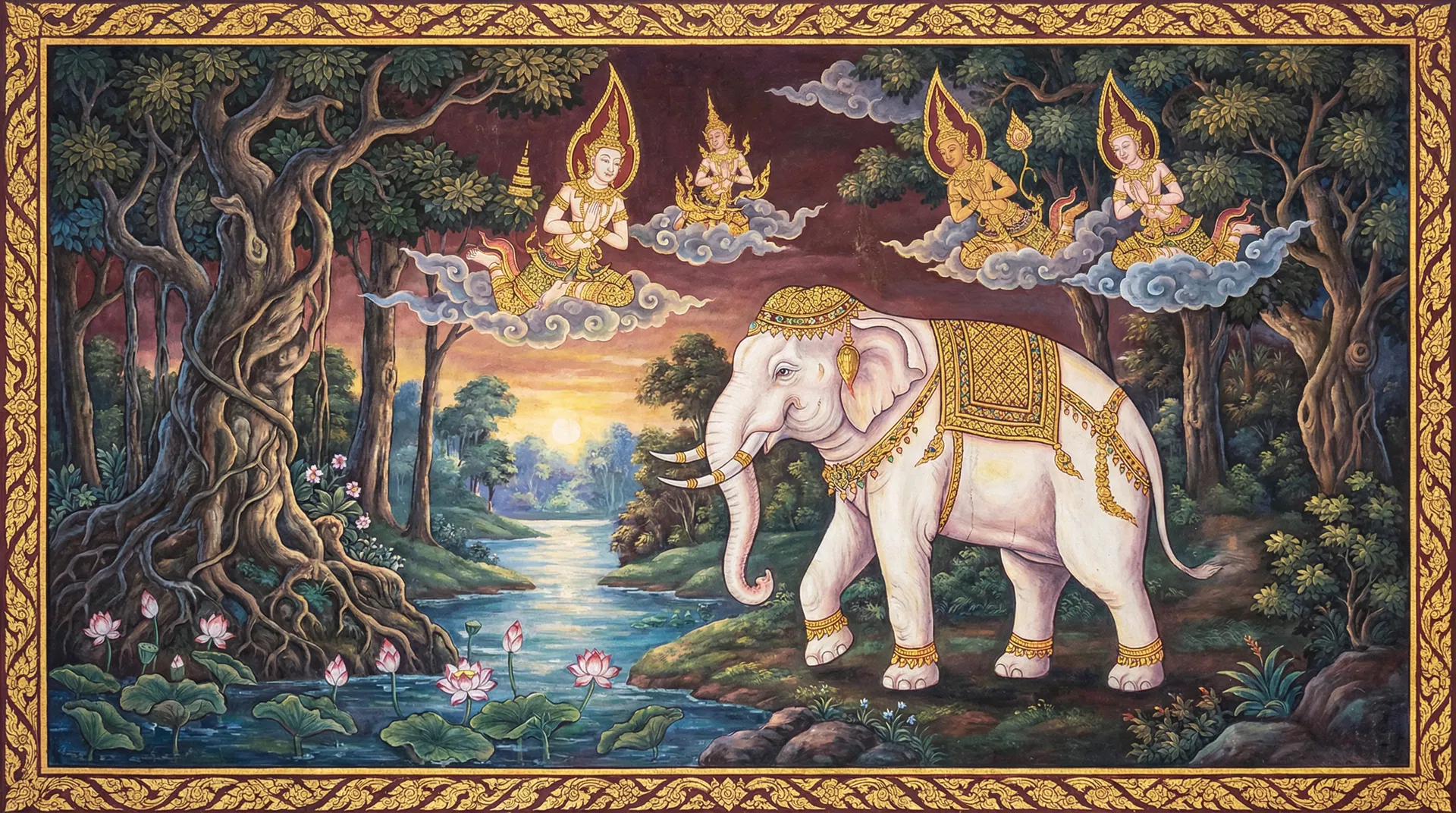
Temiya Jataka
Temiya Jataka
In the grand city of Varanasi, nestled beside the sacred Ganges, ruled a wise and just king. He and his queen were beloved by their people, and their reign was marked by peace and prosperity. Yet, despite the outward success of their kingdom, a deep sorrow lingered in the queen's heart. For years, she had longed for a child, a son to inherit the throne and carry on their legacy. Finally, her wish was granted, and she became pregnant with a son.
As the queen's pregnancy progressed, she began to experience strange and disturbing visions. She saw dark omens, heard ominous whispers, and felt an overwhelming sense of dread associated with childbirth and the subsequent responsibilities of kingship. She dreamt of infernal realms, of suffering beings, and of the karmic consequences of a ruler's actions. These visions became so intense that she grew deeply fearful of her unborn child, believing he was destined for a terrible fate.
When the son was finally born, he was named Prince Temiya. He was a beautiful and healthy child, but from the moment of his birth, he seemed different. He was unnaturally quiet, his eyes wide with an ancient wisdom, and he showed no interest in the usual joys of childhood. He cried only when he saw the king preparing for his royal duties, or when he witnessed any act that seemed to involve the accumulation of worldly karma, such as the levying of taxes or the dispensing of justice.
The queen's fears were amplified by her son's unusual behavior. She interpreted his quietness and his aversion to royal duties as signs of his impending doom, confirming her deepest anxieties. The king, though concerned, remained hopeful, believing that his son would eventually grow out of his peculiar ways.
As Prince Temiya grew older, his aversion to worldly life only deepened. He observed the suffering that seemed to be an inevitable part of human existence, caused by greed, hatred, and delusion. He saw the cycle of birth, old age, sickness, and death, and the endless suffering that arose from attachment to impermanent things. He realized that the pursuit of power, wealth, and pleasure only led to further entanglement in the cycle of rebirth and suffering.
One day, Prince Temiya made a momentous decision. He declared to his parents that he could no longer bear to witness the suffering inherent in worldly existence and that he wished to renounce his royal heritage. He announced that he would pretend to be lame, blind, and deaf, effectively becoming useless to his kingdom, in the hope that his parents would eventually allow him to leave and pursue a life of spiritual solitude.
The king and queen were devastated. They pleaded with him, tried to reason with him, and even threatened him, but Temiya remained steadfast. He meticulously maintained his act, never wavering in his feigned disabilities. He refused to participate in royal ceremonies, to learn the arts of warfare, or to engage in any activity that would bind him to the throne.
For sixteen long years, Prince Temiya maintained his charade. His parents, heartbroken and bewildered, eventually resigned themselves to their son's fate. They believed that he was indeed incapable of ruling and that his only path lay in renunciation. They finally allowed him to leave the palace, granting him permission to live as a recluse.
As Temiya walked away from the palace, he felt an immense sense of liberation. He had successfully escaped the bonds of worldly attachment and the cycle of suffering. He found a quiet place in the forest, far from the clamor of the city, and dedicated himself to deep meditation and the cultivation of wisdom. He lived a life of extreme asceticism, practicing detachment and mindfulness, striving for enlightenment.
His profound spiritual practice, born out of a deep understanding of karma and the suffering of existence, led him to attain a high level of spiritual realization. He became an arahant, a fully enlightened being, free from all defilements and the cycle of rebirth.
The story of Prince Temiya is a powerful testament to the Bodhisatta's profound understanding of the suffering inherent in worldly life and his unwavering determination to escape the cycle of Samsara. It highlights the importance of renunciation, detachment, and the relentless pursuit of spiritual liberation as the ultimate goal.
— In-Article Ad —
💡Moral of the Story
True liberation comes from understanding the impermanence of worldly life and the suffering it entails, leading to detachment and the pursuit of spiritual freedom.
Perfection: Renunciation (Nekkhamma), Wisdom (Panna), Patience (Khanti)
— Ad Space (728x90) —
More Jataka Tales You May Enjoy
 395Chakkanipāta
Saddanta Jataka
Saddanta JatakaIn the dense, ancient forests of the Himalayas, there roamed a magnificent white elep...
💡 Greed leads to suffering and emptiness. True happiness comes from detachment, compassion, and inner virtues.
 175Dukanipāta
Nimi Jātaka
Nimi JātakaIn the ancient and prosperous kingdom of Mithila, there reigned a virtuous king named Nim...
💡 Actions have consequences, both in this life and in the next. Virtuous deeds lead to happiness and celestial rewards, while unwholesome actions result in suffering. Living a life of righteousness is the path to true and lasting fulfillment.
174DukanipātaKuṅkuṇavaṅga Jātaka
Kuṅkuṇavaṅga JātakaIn the verdant land of Kasi, a kingdom renowned for its vibrant silks and skilled...
💡 True mastery and excellence are achieved through unwavering patience, dedication, and meticulous attention to detail. Haste and impatience lead to flaws and mediocrity.
211DukanipātaKhaggavisana Jataka
The Horned Solitary OneIn the ancient city of Mithila, nestled amidst lush gardens and bustling mark...
💡 True happiness and peace are found through inner cultivation, detachment from worldly desires, and self-reliance, much like a solitary rhinoceros finds strength in its own horn.
 273Tikanipāta
Assaka Jataka
Assaka JatakaIn the heart of a vast and ancient kingdom, there once lived a king named Assaka. King ...
💡 True leadership is not determined by birthright or status, but by demonstrated character, inner strength, humility, and a commitment to serving others.
224DukanipātaKhadiranga Jataka
Khadiranga JatakaIn the ancient city of Ujjeni, a hub of trade and learning, there once lived a king...
💡 True strength is not found in military might or aggression, but in righteousness, compassion, and the ability to win hearts through kindness and understanding. Peaceful resolution and the well-being of people are the ultimate measures of a ruler's power.
— Multiplex Ad —